Ap Psychology Ch 2 Research Methods Reading Supplement True and False
Discover xviii more articles on this topic
Steps of the scientific method are shaped like an hourglass - starting from general questions, narrowing down to focus on one specific aspect, and designing research where we tin can observe and analyze this aspect. At last, we conclude and generalize to the real world.

Formulating a Enquiry Problem
Researchers organize their research by formulating and defining a research problem. This helps them focus the research procedure and so that they can depict conclusions reflecting the real earth in the best possible manner.
Hypothesis
In research, a hypothesis is a suggested caption of a phenomenon.
A null hypothesis is a hypothesis which a researcher tries to disprove. Normally, the null hypothesis represents the current view/explanation of an aspect of the globe that the researcher wants to challenge.
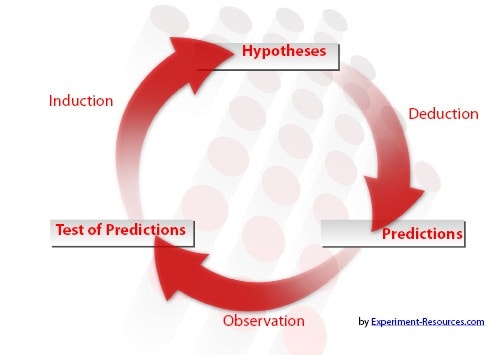
Research methodology involves the researcher providing an alternative hypothesis, a research hypothesis, equally an alternating mode to explain the miracle.
The researcher tests the hypothesis to disprove the cypher hypothesis, not because he/she loves the research hypothesis, just because it would mean coming closer to finding an answer to a specific problem. The research hypothesis is often based on observations that evoke suspicion that the zilch hypothesis is not always correct.
In the Stanley Milgram Experiment, the naught hypothesis was that the personality determined whether a person would hurt another person, while the research hypothesis was that the part, instructions and orders were much more important in determining whether people would hurt others.

Variables
A variable is something that changes. It changes according to unlike factors. Some variables change easily, like the stock-commutation value, while other variables are almost constant, like the name of someone. Researchers are often seeking to measure variables.
The variable can be a number, a proper noun, or anything where the value can change.
An example of a variable is temperature. The temperature varies according to other variable and factors. Yous tin can measure different temperature inside and exterior. If it is a sunny twenty-four hour period, chances are that the temperature will be higher than if it's cloudy. Some other matter that can make the temperature change is whether something has been done to manipulate the temperature, like lighting a burn down in the chimney.
In research, you typically define variables according to what you're measuring. The independent variable is the variable which the researcher would similar to measure (the cause), while the dependent variable is the effect (or assumed effect), dependent on the independent variable. These variables are frequently stated in experimental enquiry, in a hypothesis, e.g. "what is the result of personality on helping behavior?"
In explorative enquiry methodology, e.thou. in some qualitative research, the contained and the dependent variables might not be identified beforehand. They might not be stated because the researcher does not have a clear idea yet on what is really going on.
Confounding variables are variables with a meaning effect on the dependent variable that the researcher failed to control or eliminate - sometimes because the researcher is not aware of the effect of the confounding variable. The key is to identify possible confounding variables and somehow effort to eliminate or command them.
Operationalization
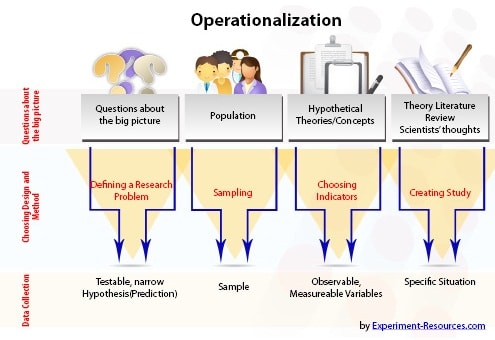
Operationalization is to take a fuzzy concept (conceptual variables), such every bit 'helping behavior', and try to measure information technology by specific observations, due east.g. how likely are people to help a stranger with problems.
See too:
Conceptual Variables
Choosing the Research Method
The choice of the research method is crucial for what conclusions you tin can brand about a miracle. It affects what you can say nearly the cause and factors influencing the phenomenon.
Information technology is also of import to choose a enquiry method which is inside the limits of what the researcher can do. Fourth dimension, money, feasibility, ethics and availability to measure the phenomenon correctly are examples of issues constraining the enquiry.
Choosing the Measurement
Choosing the scientific measurements are also crucial for getting the correct conclusion. Some measurements might not reflect the real world, considering they do not measure the phenomenon as it should.
Results
Significance Test
To test a hypothesis, quantitative research uses significance tests to determine which hypothesis is right.
The significance test tin show whether the null hypothesis is more likely right than the research hypothesis. Research methodology in a number of areas similar social sciences depends heavily on significance tests.
A significance test may even drive the research process in a whole new direction, based on the findings.
The t-exam (also called the Student's T-Exam) is one of many statistical significance tests, which compares ii supposedly equal sets of data to see if they actually are alike or non. The t-exam helps the researcher conclude whether a hypothesis is supported or not.
Drawing Conclusions
Cartoon a conclusion is based on several factors of the research process, not merely because the researcher got the expected result. Information technology has to be based on the validity and reliability of the measurement, how good the measurement was to reverberate the real earth and what more could have afflicted the results.
The observations are often referred to equally 'empirical evidence' and the logic/thinking leads to the conclusions. Anyone should be able to cheque the ascertainment and logic, to see if they besides reach the same conclusions.
Errors of the observations may stem from measurement-problems, misinterpretations, unlikely random events etc.
A common error is to recollect that correlation implies a causal human relationship. This is not necessarily true.
Generalization
Generalization is to which extent the research and the conclusions of the research use to the real world. Information technology is non always so that skilful enquiry will reflect the existent world, since nosotros tin just measure a minor portion of the population at a time.

Validity and Reliability
Validity refers to what caste the enquiry reflects the given enquiry problem, while Reliability refers to how consistent a set of measurements are.

Types of validity:
- External Validity
- Population Validity
- Ecological Validity
- Internal Validity
- Content Validity
- Face up Validity
- Construct Validity
- Convergent and Discriminant Validity
- Exam Validity
- Criterion Validity
- Concurrent Validity
- Predictive Validity
A definition of reliability may be "Yielding the same or compatible results in different clinical experiments or statistical trials" (the free dictionary). Enquiry methodology lacking reliability cannot be trusted. Replication studies are a manner to exam reliability.
Types of Reliability:
- Test-Retest Reliability
- Interrater Reliability
- Internal Consistency Reliability
- Instrument Reliability
- Statistical Reliability
- Reproducibility
Both validity and reliability are important aspects of the research methodology to go better explanations of the world.
Errors in Research
Logically, there are two types of errors when drawing conclusions in research:
Blazon i mistake is when nosotros accept the research hypothesis when the nil hypothesis is in fact correct.
Type 2 mistake is when nosotros decline the research hypothesis even if the null hypothesis is incorrect.
Source: https://explorable.com/research-methodology
0 Response to "Ap Psychology Ch 2 Research Methods Reading Supplement True and False"
Postar um comentário